Have you ever studied a new material, and have forgotten almost immediately after using it (for work, or for an exam)? Have you ever forgotten something you thought you had understood well? Are you trying to learn a new language and forget the new vocabulary all the time?
Well, that happens to me, as well. You are not alone. In my case, I have found a solution in the form of a technique, the so-called spaced repetition.
You see, a long time ago, the psychologist Hermann Ebbinghaus described a model that he called the forgetting curve.
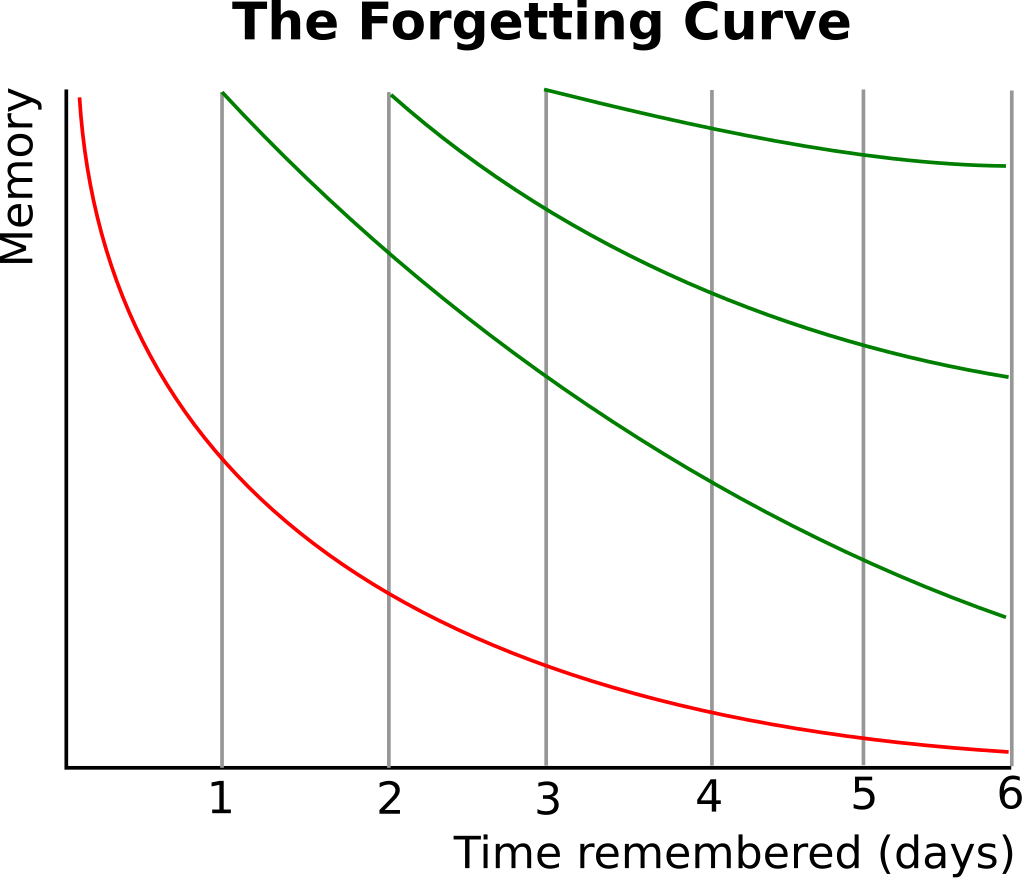
The red line is an estimation about the duration of a piece of information in our brain. Well, we were not there to confirm his methods, the man lived around 150 years ago.
I have seen many sites promoting spaced repetition and the forgetting curve concepts. Could these help us study and learn better? Well, I don’t the budget to perform a scientific study, thus, I’d try on myself. And I have to say that it has worked so far.
How have I tested it? Well, the theory says if you study a material and understand it, then you repeat or examine yourself about it, at different intervals, longer if you answer correctly and shorter if you answer wrong, then you should be able to remember for a long time (look at the green lines in the image). For saving myself the need for calculating these intervals I’m using the program Anki.
Anki is a program where you can create flashcards for examining yourself on material that you have understood, already (if you have not understood it, do NOT create flashcards for it). https://apps.ankiweb.net/
The method goes like this:
- Study the material focusing on learning objectives. What do you want to accomplish by learning this topic? Get a new job? Pass an exam? Learn a new language?
- Once you have identified your goal, research which are the highest yield topics of this theme. For that, scan quickly a few books about it. Look at the tables of content, the last paragraphs of each chapter, the learning objectives described per chapter, and the introductions and summaries.
- Create questions based on what you learned on step 2. Place front and center your learning goal developed on point 1. Which is the Minimum Viable Content required to accomplish your goal?
- Study each chapter for answering your questions. How do the different topics relate to your learning goal?
- Eliminate or reduce any piece of information that it is not helping you to accomplish the goal.
- Divide into shorter ideas the remaining information. Make them as short as possible (no longer, no shorter than needed).
- Create Anki flashcards with these ideas.
Anki will take care of calculating the intervals and test you so that you do not forget the material.
In a future article, we will see how to use Anki.
Cheers!